In a valiant attempt to use up my annual leave before the end of the leave year I took the day off. However, as ever, my inability to have a lie-in led me getting on the overground at just before 9am. What I discovered was that commuting after 8am is a very different experience to my usual route to work. In hindsight I question why I would feel compelled to travel to Whitechapel at such an hour to buy some bamboo canes for my tomatoes. However, I'll allow the qualified psychologists amongst you to delve into my inner psyche.
Regardless, I obtained 6 novelty sized canes for the reasonable price of £1.50 and headed over to St Katharine Docks to get a coffee from White Mulberries to try a latte made from their current guest espresso, Nude, of Brick Lane. Despite the heat and lugging around both my e-reader and novelty canes I'm glad I did; Nude's beans make a lovely smooth espresso, and with due care and attention given to the milk from the barista, makes for a rich, velvety latte with a distinct cocoa flavour and a delicate crema. The mild flavour profile provides a contrast (and thus an excellent stablemate) to White Mulberries' house espresso from Allpress.
Making my way back home via Waitrose, I walked down the canal and was amazed to see the hundreds of small damselflies hovering above the water. Slightly more odd was reaching the basin and seeing a straggly haired fellow swimming in the basin.
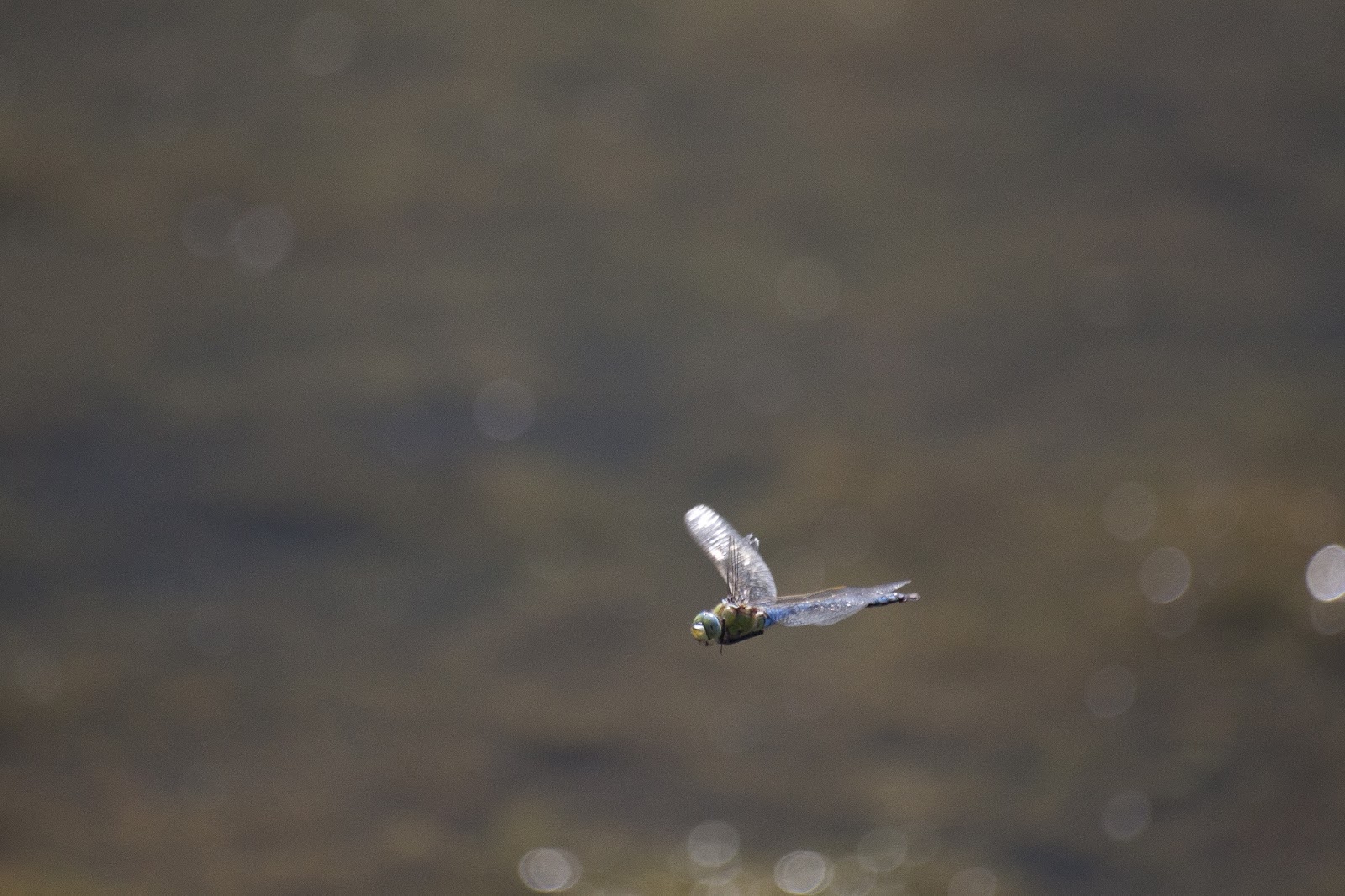
What I was really struck by though was a handful of larger flying insects that I think are dragonflies (I'm not an entomologist, so apologies if this is spurious). On getting home, I dropped off my shopping, rejigged my tomatoes with novelty canes and headed back out with my camera.
Lessons on the basin were in full swing, with both dinghies and kayaks on the water.
Having just returned from Whitechapel, seeing the Air Ambulance flying overhead made me think that helicopter would be a speedier means of transport than the D3, and a reminder of how important a service the Air Ambulance offers.
Also on the basin was a large group of ducks, seemingly sticking together in solidarity. Walking round to the canal, I met the newest brood of mallard ducklings. As I took some photos I became aware of the looming presence of a chap with a rather large net. Chatting with him, he introduced himself as Aaron, and his net as belonging to the sailing club, readying himself to try and lift the ducklings out of the canal and into the basin. Aaron told me about youths which had stoned the last brood of ducklings and the extent of duck poaching and the landing of fish that has been going on. Despite some perpetrators having been caught red handed by the police these incidents continue to occur.
At this point we were also joined by Dom, a neighbour of Aaron and LBTH's biodiversity officer. The chap from the council wasn't keen on netting the ducklings, so a floating piece of chip board was commissioned into a ramp in the hope the ducks would sort themselves out. Dom also explained that in addition to adult ducks being poached and ducklings being stoned, any ducklings trapped in the canal were also at the mercy of foxes.
Leaving the ducks to get on with their escape plan, I returned to my original plan of taking some photos of the insects, whilst Aaron chatted to the chap from the council. It appears as ever that there is no joined up thinking, with every authority one can imagine stating that a given aspect of wildlife protection is the responsibility of a different agency or organisation. Everyone denies owning the basin, the Council is prepared to accept responsibility for the canal but not for crime, the police see ASB as something the council needs to deal with etc etc ad nauseam. Aaron flagged up Love Wapping's blog post on the cygnet death to the Chap from the Council (I understand that Aaron and Dom may in fact be deputized LW Wildlife Rangers).
As we were about to go our separate ways, two fellows on scooter and motorbike drove over Brussels Wharf and stripped off and began diving by a coot's nest. Almost immediately a white staffie started barking at the swans in the south-east corner of the basin. It was quite clear to me from just a few minutes talking to Aaron some of the problems wildlife in the area have to face. As we made our goodbyes, the white staffie and its owner had reached the canal, at which point the dog climbed out on to the stone of the terraced steps on the canal and made it known it was interested in duck for dinner. Fortunately however the duck escaped, though without any intervention from its owner. His lady friend instead picked up a stick and started jabbing in the vicinity of the ducks.
Having let Aaron know how to find me if he needed future assistance (give a little whistle), I made my way down the canal. I discovered that taking photos of flying insects is rather difficult - I managed a handful of shots in focus out of about 200. However, I now have plenty of practice in manual focusing. However, I'm rather pleased with what I managed to achieve.
By the time I returned home, the number of swimmers, divers and sunbathers on the pontoon and Brussels wharf had swollen, unaware of some of the unintended consequences of the actions of others, including previously damaging the sailing clubs pontoon. Realizing the number of people in bathing costumes, I put away the camera and headed home.
Showing posts with label ASB. Show all posts
The trouble with averages - Anti-social behaviour
Last week saw the publication of at least two news stories on anti-social behaviour (ASB) in local news papers (The Wharf and East London Advertiser) based on a Tower Hamlets Labour Party press release (here) and even saw the creation of an infographic!
Jim Fitzpatrick used FOI requests and parliamentary questions to obtain the data. I on the other hand just used the freely available data published by the police nationally and didn't trouble anyone. I'm using data down at a ward/neighbourhood level, though more granular data is available.
The Wharf interpreted the data (ie press release) by stating that:
Even in Tower Hamlets there are reasonably significant variations in ASB, with Bethnal Green South, Spitalfields, Weavers and Whitechapel having ASB rates that are markedly higher than other areas in the Borough, albeit to a less striking extent than in Westminster. These to my mind correlate broadly to key thoroughfares and areas of entertainment. However, I cannot conclude this without drilling down into the data, but the presence of high levels of ASB around Whitechapel Road, Commercial Road, Bethnal Green Road, Brick Lane and Spitalfields seems quite intuitive.
Contextualising by looking at a ward-by-ward level for both LBTH and Westminster, we can see that actually, ASB in the West End dwarfs anything in the East End. Other than being annoyed by drunks, I have never felt unsafe in Central London at night or in the day, but, ASB is clearly reported at a much greater rate than in Tower Hamlets, where I do sometimes feel uncomfortable, so we also need to consider the nature of ASB and how each individual instance affects people.
So what should we conclude? Jim Fitzpatrick is quoted in the press release as saying:
Both LBTH and Westminster have a similar number of reported incidents of ASB, yet Westminster has two and a bit times more reported crime as shown below. ASB may be annoying, and it may make people people unsafe, but we shouldn't overplay the issue when we can't understand what the data says, particularly when we think of the myriad offences that can be classed as ASB.
Jim Fitzpatrick used FOI requests and parliamentary questions to obtain the data. I on the other hand just used the freely available data published by the police nationally and didn't trouble anyone. I'm using data down at a ward/neighbourhood level, though more granular data is available.
The Wharf interpreted the data (ie press release) by stating that:
A total of 17,287 incidents were recorded by the police in the east London borough last year, putting it second, behind only Westminster City Council, home to the West EndThe ELA went with:
Only Westminster had a higher rate of ASB than Tower Hamlets, with nightlife hotspots such as Soho accounting for many reports.So far, so unoriginal. Looking at the data at a borough level is interesting, but hides massive levels of variation within each borough. Within Westminster, the level of ASB is significantly higher in areas around the West End than compared to say Bayswater, Belgravia, Marylebone and Regent's Park. If you were to strip out the figures for the West End, the ASB rate for Westminster would be 33 per cent lower.
Even in Tower Hamlets there are reasonably significant variations in ASB, with Bethnal Green South, Spitalfields, Weavers and Whitechapel having ASB rates that are markedly higher than other areas in the Borough, albeit to a less striking extent than in Westminster. These to my mind correlate broadly to key thoroughfares and areas of entertainment. However, I cannot conclude this without drilling down into the data, but the presence of high levels of ASB around Whitechapel Road, Commercial Road, Bethnal Green Road, Brick Lane and Spitalfields seems quite intuitive.
Contextualising by looking at a ward-by-ward level for both LBTH and Westminster, we can see that actually, ASB in the West End dwarfs anything in the East End. Other than being annoyed by drunks, I have never felt unsafe in Central London at night or in the day, but, ASB is clearly reported at a much greater rate than in Tower Hamlets, where I do sometimes feel uncomfortable, so we also need to consider the nature of ASB and how each individual instance affects people.
So what should we conclude? Jim Fitzpatrick is quoted in the press release as saying:
"These figures show there's a lot more work to do to ensure local people feel safe in their neighbourhood."From my perspective, the data doesn't show this. What it shows is that the level of reported ASB in LBTH is relatively high, but doesn't necessarily feed into making a statement about safety, or how perceptions of ASB varies across the borough. If there are key hotspots where ASB is focussed, individuals living near these hotspots may feel unsafe, but we cannot extrapolate this across a population of 200,000 people.
Both LBTH and Westminster have a similar number of reported incidents of ASB, yet Westminster has two and a bit times more reported crime as shown below. ASB may be annoying, and it may make people people unsafe, but we shouldn't overplay the issue when we can't understand what the data says, particularly when we think of the myriad offences that can be classed as ASB.
There used to be data on this issue, though alas the Government ended collection of National Indicators after 2010. What the last dataset to be published showed was that LBTH had the second highest perceived level of ASB, with 46 per cent of survey respondents having a strong perception of ASB, compared to 20 per cent in Westminster - yet both have identical levels of reported ASB, suggesting, that reported ASB is not the metric to measure people's perceived safety on.
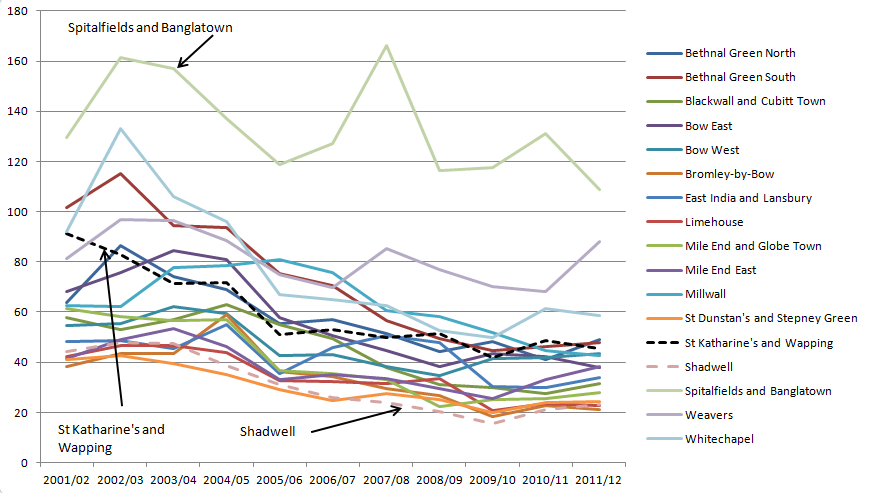
One final note - from my previous research, we do actually know that crime decreased significantly over most wards in Tower Hamlets in the 11 years to 2012.
Subscribe to:
Posts (Atom)